For the normal learner practical driving test, you will need to know how to perform four standard manoeuvres, each involving reversing your vehicle:
• Forward parking: park in a bay by driving in and then reversing out.
• Reversing parking: reverse into a parking bay.
• Reverse parallel parking: pull up along side a car on the left and reverse park behind.
• Pull up on the right: pull up on the right-hand side of the road, reverse 2 car lengths and rejoin the traffic.
(Note: the 'turn in the road' and 'reverse around a corner' manoeuvres are no longer explicitly examined, but should still be known and practiced, and indeed could still be required if for example you took a wrong turn into a no through road.)
Your examiner will randomly select one of these manoeuvres for you to perform on your driving test.
Your Instructor will help you develop the necessary skills to perform each manoeuvre safely and correctly. Each manoeuvre will require careful vehicle control whilst taking effective observations to deal with other road users and pedestrians. The manoeuvres are typically introduced / practiced in the order of difficulty as each subsequent manoeuvre builds on the skills previously learnt.
Be patient - each manoeuvre takes time to master; you will need to practice them many times with your Instructor.
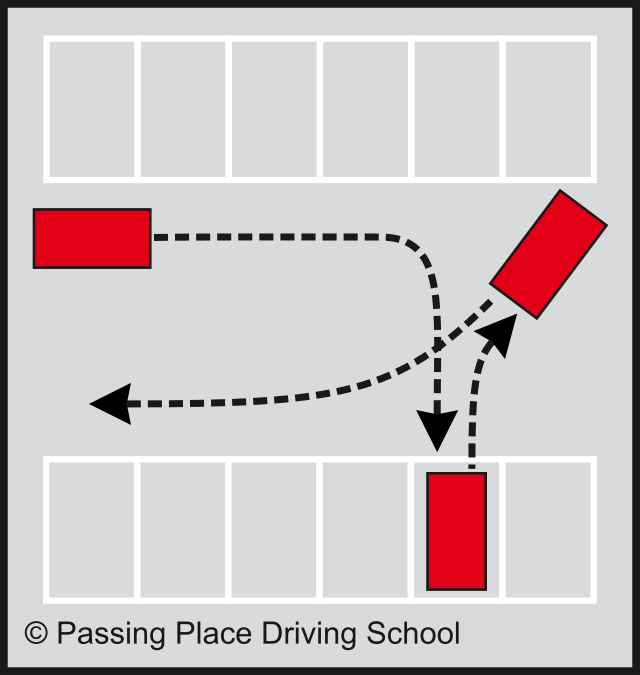
This parking manoeuvre involves turning at a right-angle (either on the left or the right) to then drive straight into a bay. You must then reverse out of the bay, being careful of other vehicles and pedestrians, and then drive away to exit the car park.
Your instructor will train you how to perform this manoeuvre in a quiet car park at first. However, on test, the examiner will typically ask you to perform this manoeuvre in a busy car park (such as a supermarket car park).
Common problems:
• starting too close to the target bay.
• incorrect turning point.
• lack of observations before turning in, reversing out, or finally driving away.
• not finishing with the bay.
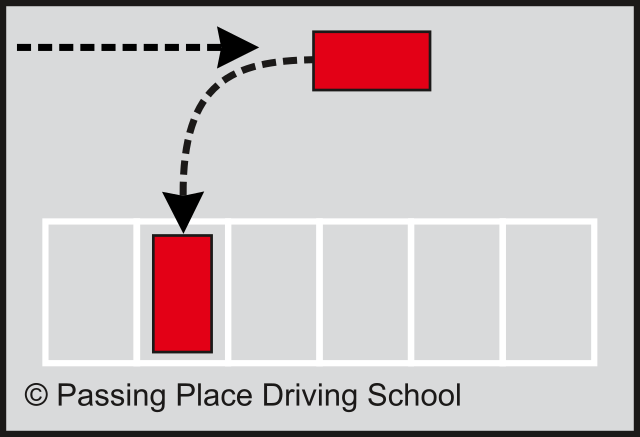
This will involve reversing into a designated parking bay, finishing squarely, fully within the bay, leaving an equal gap between the two side lines. Your instructor will teach you several ways of going about this particularly parking manoeuvre.
Common problems:
• incorrect starting position to reverse into the bay.
• not finishing within the bay with suitable accuracy.
• lack of observation to the rear of the vehicle whilst performing the manoeuvre.
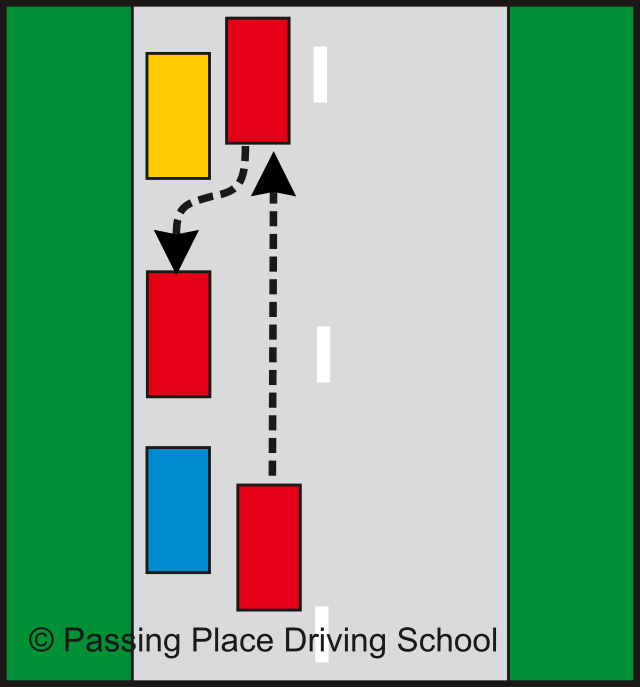
This manoeuvre is what is used to park your vehicle into a limited gap on a side street. (This manoeuvre can be performed on either the left or right hand side of the road, though for the learner driving test only the left hand side is used.)This park requires the most accuracy and is therefore typically left until last. However, don't fear - the examiner will not make you park in tight space - typically you will be required to complete the park within a gap of about two car lengths, you probably will not have a car too close behind. You will need to have precise vehicle control to perform this manoeuvre accurately.
Common problems:
• not enough observation to rear of vehicle.
• incorrect steering / approach angle.
• finishing too near (mounting curb) or too wide from curb.
• using too much space to complete the park.
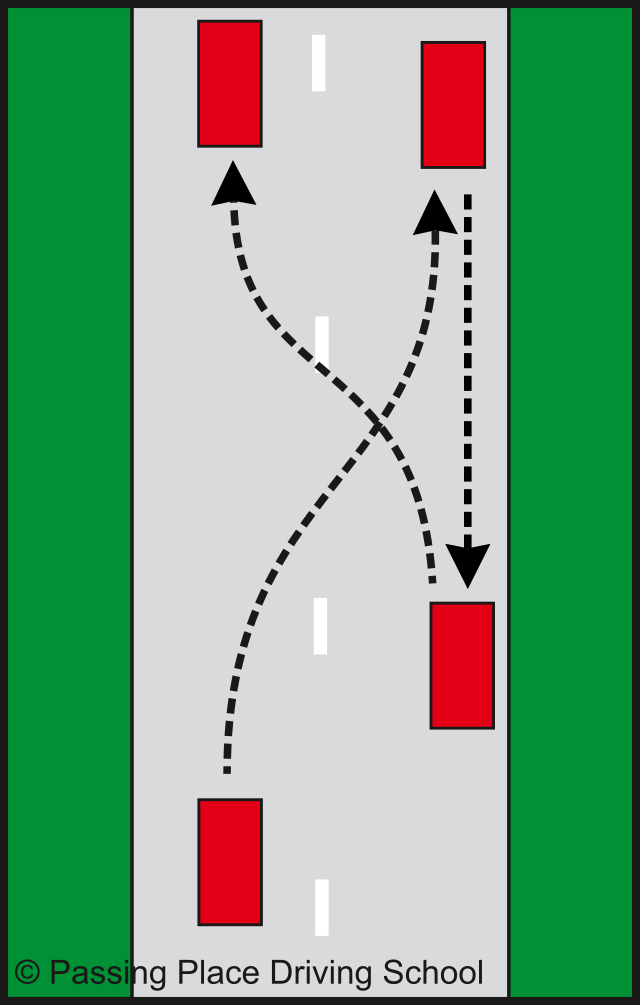
This manoeuvre will require you to pull up on the right hand side of a road, finishing suitable near to the curb. You will then reverse back approximately two car length (simulating the need to reverse if a car was parked directly in front of you) and then drive away, back into the flow of traffic.
Common problems:
• poor planning as to where and when to pull up.
• positioning without regard to other road users.
• drifting too near or too far from the curb when reversing.
• poor observation when reversing.
• misjudging a safe gap to merge back into the traffic.
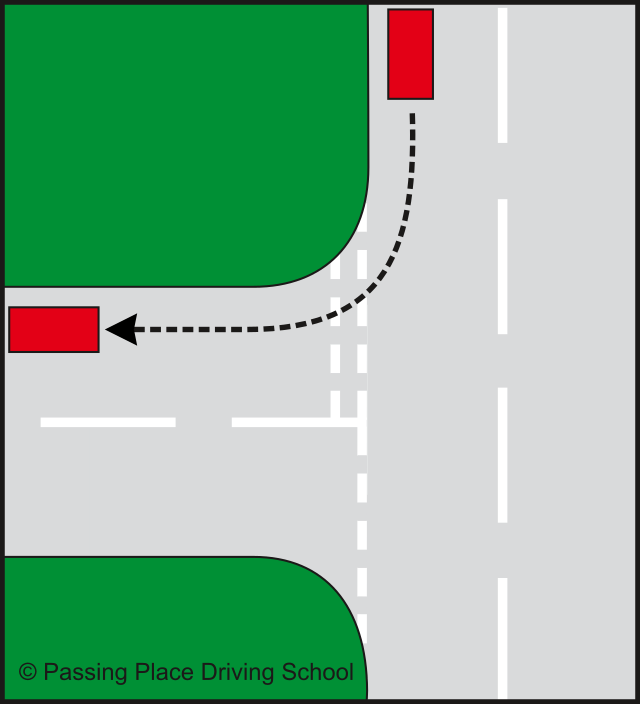
This manoeuvre is typically used to turn your vehicle around (although when it was used in a driving test is was not necessarily used for this purpose; it was more about demonstrating safe, careful vehicle control). You will need to have slow consistent control of your vehicle, keeping reasonably close to the curb throughout, whilst taking due regard of other road users and pedestrians at all times. If another road user appears during your manoeuvre, be prepared to give way, safely move out of their way, or if necessary pull forward and re-start the manoeuvre. Note that this manoeuvre can be performed from a major road into either a side road on the left or the right, but never from a side road into a major road.
Common problems:
• poor speed control, resulting in accuracy and observation faults.
• over-steering, causing you to strike or mount the curb.
• under-steering, causing you to end up too far from the curb.
• ineffective observation / not responding to other road users and pedestrians.
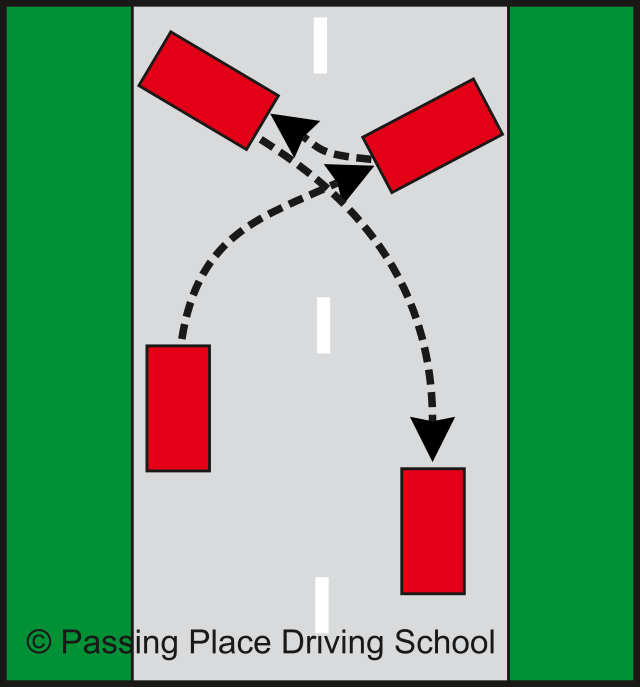
When this was used on the driving test the examiner referred to this manoeuvre as a 'turn in the road using forward and reverse gears' and not a 'three-point turn' (as it is more commonly known). This is because the number of 'points' will vary depending on the width of the road chosen. That said, once you develop the skills to a high level, you will find the manoeuvre typically takes three-points to complete, unless the road is very narrow, in which case it is more likely to take 5 (or even more) points. You will need careful vehicle control, effective steering, and good observation throughout to deal correctly with other road users / pedestrians. Be prepared to give way to other road users when correct to do so, and if a road user is prepared to wait for you, don't panic, but try to complete the manoeuvre promptly.
Common problems:
• poor speed and or steering control.
• inadequate use of the width of the road.
• hitting or mounting the curb.
• continuing the manoeuvre without due regard to other road users / pedestrians.